
The world is running dry (and our oceans are paying for it)
The world is not running low on water. It has already run out. And the ocean is next.
In January 2026, the United Nations made an announcement that should have been all over your feeds. The world has officially entered the era of "global water bankruptcy".
Those are not our words. They come from UN scientists, who published a landmark report declaring that many of the world's water systems are beyond the point of recovery.
This is not a prediction for the future. This is the present. And the ripple effects reach all the way down to the bottom of our oceans, where marine life, coastal communities, and yes, sharks are quietly suffering the consequences.
What is "water bankruptcy"?
For years, scientists talked about water stress and water crises. These terms describe situations that, in theory, can be fixed. Water bankruptcy is different.
The UN formally defines it as a persistent state where long-term water use and pollution have exceeded renewable inflows and safe depletion limits, meaning the damage is irreversible or would cost more to undo than most countries could ever afford.
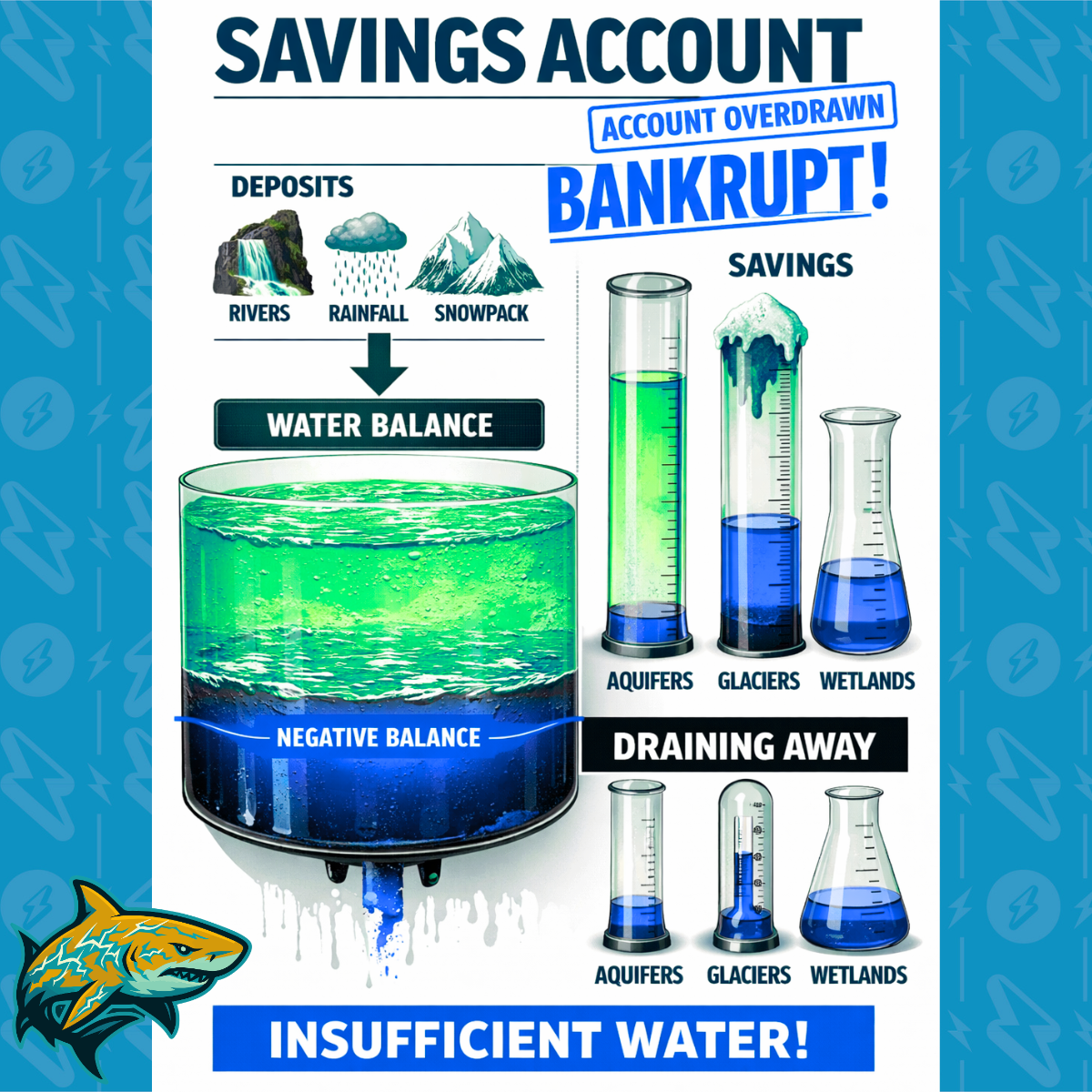
Think of it like a savings account. Rivers and rainfall are the income that tops it up every year. Aquifers, glaciers, and wetlands are the savings. The world has not only been spending every penny of income, but it has also been draining the savings at a terrifying rate. And now, for many regions, those savings are gone.
As lead author Kaveh Madani, Director of the UN University's Institute for Water, Environment and Health, put it: "Many regions are living beyond their hydrological means, and many critical water systems are already bankrupt."
The numbers that should make you do a double take
These are the facts, straight from the UN report.
• Three quarters of the world's population live in countries classified as water insecure or critically water insecure.
• 2.2 billion people lack safely managed drinking water.
• 3.5 billion people lack safely managed sanitation.
• 4 billion people face severe water scarcity for at least one month every year.
• More than half of the world's large lakes have lost water since the early 1990s.
• 410 million hectares of natural wetlands, a landmass nearly equal to the entire European Union, have been wiped out over the past five decades.
• 70% of major aquifers are in long-term decline.
• Dozens of major rivers now fail to reach the sea for parts of the year.
• More than 30% of glacier mass has already been lost in several locations since 1970.
• 1.8 billion people were living under drought conditions in 2022 to 2023.
• The annual global cost of drought currently sits at US$307 billion.
Food on your plate is at risk too
Agriculture accounts for around 72% of all global freshwater withdrawals. Three billion people and more than half of the world's food production are concentrated in areas where water storage is already declining or unstable.
Over 170 million hectares of irrigated cropland, roughly the combined land area of France, Spain, Germany, and Italy, are under high or very high-water stress. India, the world's largest rice exporter, is losing up to 30 centimetres of groundwater a year in some regions.
And we are being asked to produce 56% more food calories by 2050 to feed a projected global population of 10 billion people. With less water. More pressure. And a system already stretched past breaking point.
The human cost: disease, displacement, and conflict
Waterborne diseases including cholera, typhoid, dysentery, and hepatitis A kill an estimated 3.5 million people annually. Around 900 children under the age of five die every single day from diarrhoeal diseases caused by unsafe water. That is one child every two minutes.
UNICEF estimates that 700 million people could be displaced by water scarcity by 2030. Cities including Cape Town, Sao Paulo, and Tehran have already faced "Day Zero" emergencies, where water supplies came close to complete depletion. Kabul is currently on the brink of becoming the first major city in the world to run out of water entirely.
Water-related violence has nearly doubled since 2022, rising from 235 incidents to 419 in 2024, according to the Pacific Institute's Water Conflict Chronology. Water infrastructure is increasingly being targeted in conflicts, despite attacks on civilian water supplies being classified as a war crime under Article 54 of the Geneva Convention.
What does this mean for our oceans and marine life?
This is where it gets deeply worrying for anyone who cares about the health of our seas. The water crisis is not happening in isolation on land. What happens to rivers, wetlands, and freshwater systems has a direct knock-on effect on the ocean, and a new study from the European Commission's Joint Research Centre (JRC), published in Nature Communications in February 2025, takes a jaw-dropping deep dive into exactly that.
The research looked at what happens to the Mediterranean Sea when river flow decreases due to climate change and growing demand for water. The findings are not reassuring.
Rivers are not just waterways. They carry freshwater, nutrients, and sediments into the sea. These inputs feed the base of the marine food chain, supporting plankton, which feeds small fish, which feeds larger fish, and so on all the way up. When rivers run dry or slow to a trickle, that entire chain starts to break down.
Under an extreme but credible warming scenario of 4°C above pre-industrial levels, the study found that river flow into the Mediterranean could drop by 41%. The knock-on effects would include a 10% reduction in marine productivity and a 6% drop in fish biomass across the Mediterranean, with annual losses to the fishing industry worth €4.7 billion.
Some areas would be hit far harder. The Adriatic and Aegean Seas, which are among the most intensively fished regions in the Mediterranean, could see marine productivity fall by 12% and fish biomass plummet by 35%. To put that in perspective, the biomass losses in these areas could exceed their entire current fishery catch.
This is not a distant worst-case scenario for future generations to deal with. We are already seeing the signs. Italy's River Po, which flows into the Mediterranean, has had its water volume nearly halved on at least five separate occasions over 23 years of monitoring between 2001 and 2023. In 2022, the drop hit a record low of 39% of its long-term average flow. The river that feeds one of Europe's most productive marine regions is struggling to reach the sea at full capacity.
And around 20% of Europe's territory and 30% of its population already experience water stress every year. The Mediterranean example is not unique. It is a preview.
And yes, this is hitting sharks too
You knew we were going to get to this part. And no, we are not shoehorning it in. The connection is real and it matters enormously.
When rivers run dry and freshwater stops reaching the sea, it disrupts the salinity, temperature, and nutrient balance of coastal waters. These coastal areas are critical nursery grounds for many shark species. Baby sharks rely on shallow, sheltered coastal zones for protection and food. When those habitats are degraded by pollution, salinity changes, or the collapse of the wetlands that filter water before it reaches the sea, those nurseries disappear.
The 410 million hectares of natural wetlands destroyed over the past five decades were not empty space. They were buffers, filters, and breeding grounds. Their loss has sent polluted, unfiltered runoff directly into coastal waters, contaminating the environments sharks depend on for survival.
Sharks are also apex predators sitting at the top of a food chain that starts with plankton and small fish. When water quality deteriorates and nutrient flow from rivers declines, that food chain gets disrupted from the bottom up. Reduced marine productivity, as the JRC study demonstrates, means fewer fish at every level. By the time that ripples upward to apex predators like sharks, the impact on their food supply can be significant.
Sharks are also highly vulnerable to bioaccumulation. Toxins and pollutants from agricultural runoff and industrial contamination, the very same pollution that is poisoning our freshwater systems, travel through the marine food chain. By the time they reach a shark, concentrations can be far higher than in the original water source.
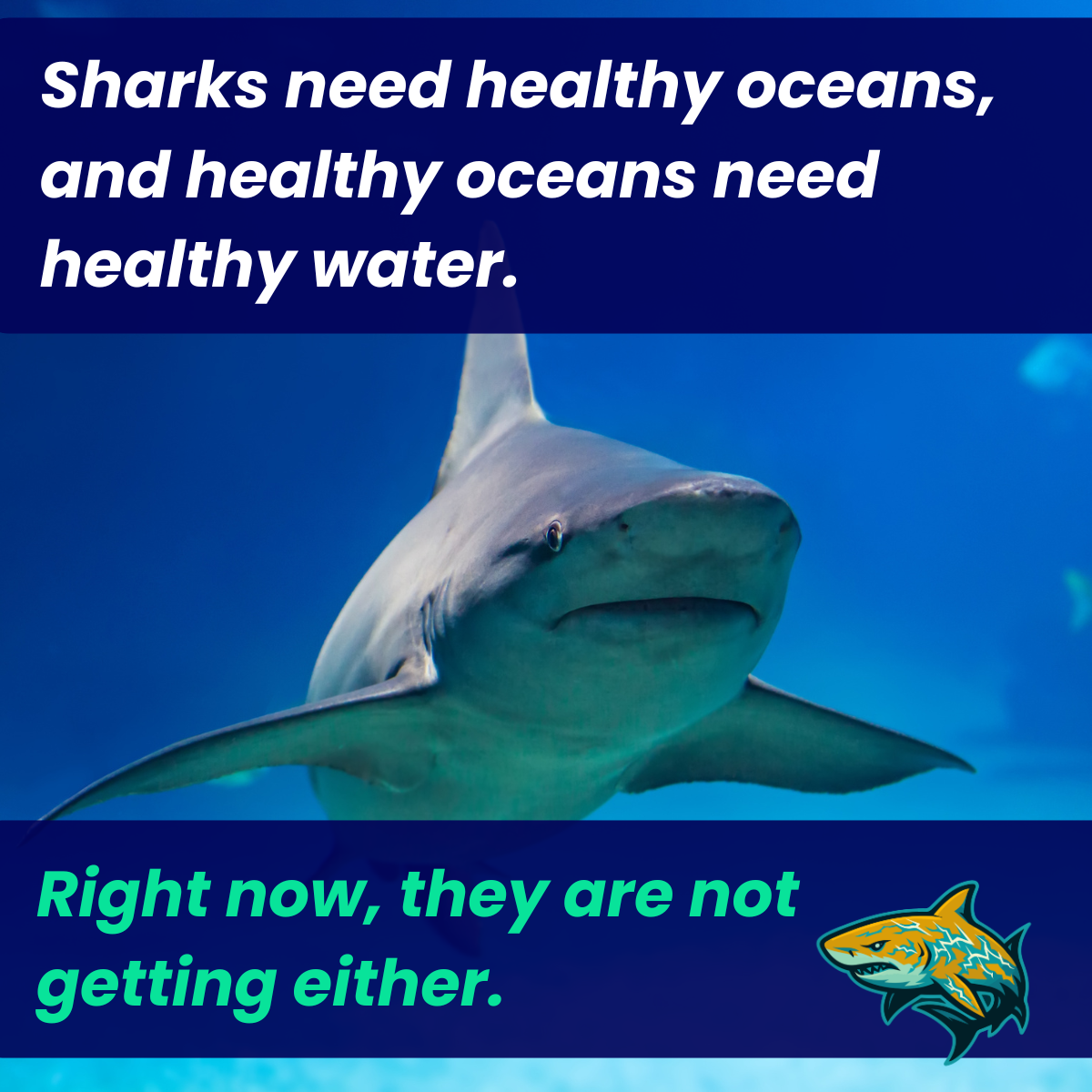
And sharks already have enough to deal with. Over 100 million sharks are killed every year. Some shark populations have declined by 90% in the last 50 years. They reproduce slowly, most species do not reach sexual maturity until they are well into their teens in shark years, and they only have a small number of young at a time. They cannot adapt at the pace that humans are destroying their environment.
Sharks are also one of the ocean's most important climate defenders. They protect seagrass meadows, which store carbon 35 times faster than tropical rainforests. They maintain the balance that keeps coral reefs alive. Deep sea sharks help recycle carbon by scavenging on the ocean floor. Without them, that carbon rises back into the atmosphere. It is estimated that sharks help remove up to half of the manufactured carbon in the atmosphere.
Lose the sharks, lose the seagrass. Lose the seagrass, release the carbon. And we are already living in a world that cannot afford more carbon.
Sharks have been swimming in our oceans for over 400 million years. They survived ice ages, asteroid impacts, and mass extinction events. They might not survive us. And that is the scariest story of all.
What happens next?
The UN report is not asking us to give up. It is asking for a complete shift in how we think about water, moving from short-term crisis management to long-term bankruptcy management.
That means stopping further irreversible damage, transforming water-intensive industries, protecting what natural water capital remains, and building systems that can monitor and respond to ongoing changes.
The 2026 UN Water Conference, taking place in December in the UAE, is one of only two major international meetings on water governance this century. The next is in 2028.
As Madani put it: "Declaring bankruptcy is not about giving up. It is about starting fresh. The longer we delay, the deeper the deficit grows."
A word from us at Sparky Shark Marketing
We are a marketing agency. That is what we do day to day. We write blogs, create content, manage social media, help businesses find their voice, and make sure their marketing has bite.
But we also built this brand around sharks. And that means we use our platform to talk about things that matter beyond marketing strategies and content calendars.
We care about ocean health. We care about marine life. We care deeply about sharks, not because they are our logo, but because they are vital to the survival of our oceans and, by extension, our planet.
Stay curious. Use your voice. And maybe think twice about that dripping tap. The ocean is counting on us.
Thanks for reading.🦈
Sources
UN University Institute for Water, Environment and Health (UNU-INWEH), Global Water Bankruptcy: Living Beyond Our Hydrological Means in the Post-Crisis Era, January 2026. doi: 10.53328/INR26KAM001
Madani K. (2026) Water Bankruptcy: The Formal Definition, Water Resources Management, 40 (78). doi: 10.1007/s11269-025-04484-0
Anderson, S. (2026) World Enters New Era of Water Crisis, UN Says. Health Policy Watch, 28 January 2026.
Concern Worldwide (2026) 10 Causes of Water Scarcity Contributing to Our Current Crisis, 25 March 2026.
European Commission Joint Research Centre (2025) Water scarcity poses risk to Mediterranean marine life and economy. Nature Communications, 3 February 2025.
