Why we’re screwed without sharks
In short, we are screwed without sharks!
Sharks get a terrible reputation. Thanks to Hollywood and sensationalised news stories, most people think they're nothing more than mindless killing machines.
But sharks are essential to ocean ecosystems. And without them, we're all in serious trouble.
So let's talk about why these magnificent creatures deserve respect, not fear.
🦈Sharks are the ocean's quality control managers
As apex predators, sharks keep fish populations in check by preying on sick, weak, or overabundant animals.
When shark numbers decline, the ripple effects are massive.
In areas where sharks have disappeared, populations of mid-level predators like groupers have exploded. These fish consume smaller herbivores that normally graze on algae. Without enough plant-eating fish, algae quickly takes over coral reefs, making it harder for corals to grow and recover from stress like storms or warming waters.
By keeping prey populations balanced, sharks indirectly support biodiversity and protect critical habitats like coral reefs. Their presence ensures no single species dominates the food web.
Think of sharks as the managers who ensure the whole team functions properly. Remove them, and everything falls apart.
Simple as that.

🦈Sharks protect the ocean's most important habitats
Sharks do more than regulate prey populations, they protect coral reefs, kelp forests, and seagrass meadows.
🪸Coral reefs:
By keeping mid-level predator populations in check, sharks maintain the balance needed for coral reefs to stay healthy. Too many predators mean fewer herbivorous fish. Fewer herbivores mean algae overgrowth. Algae overgrowth means dying reefs.
Sharks stop this domino effect before it even starts.
🌊Kelp forests:
In kelp forests, sharks reduce pressure from predators that feed on sea urchins - major grazers of kelp. This keeps urchin populations in check, preventing them from overgrazing and clearing out large sections of kelp.
The result? Thriving kelp forests that provide food, shelter, and breeding grounds for countless marine species.
🐢Seagrass meadows:
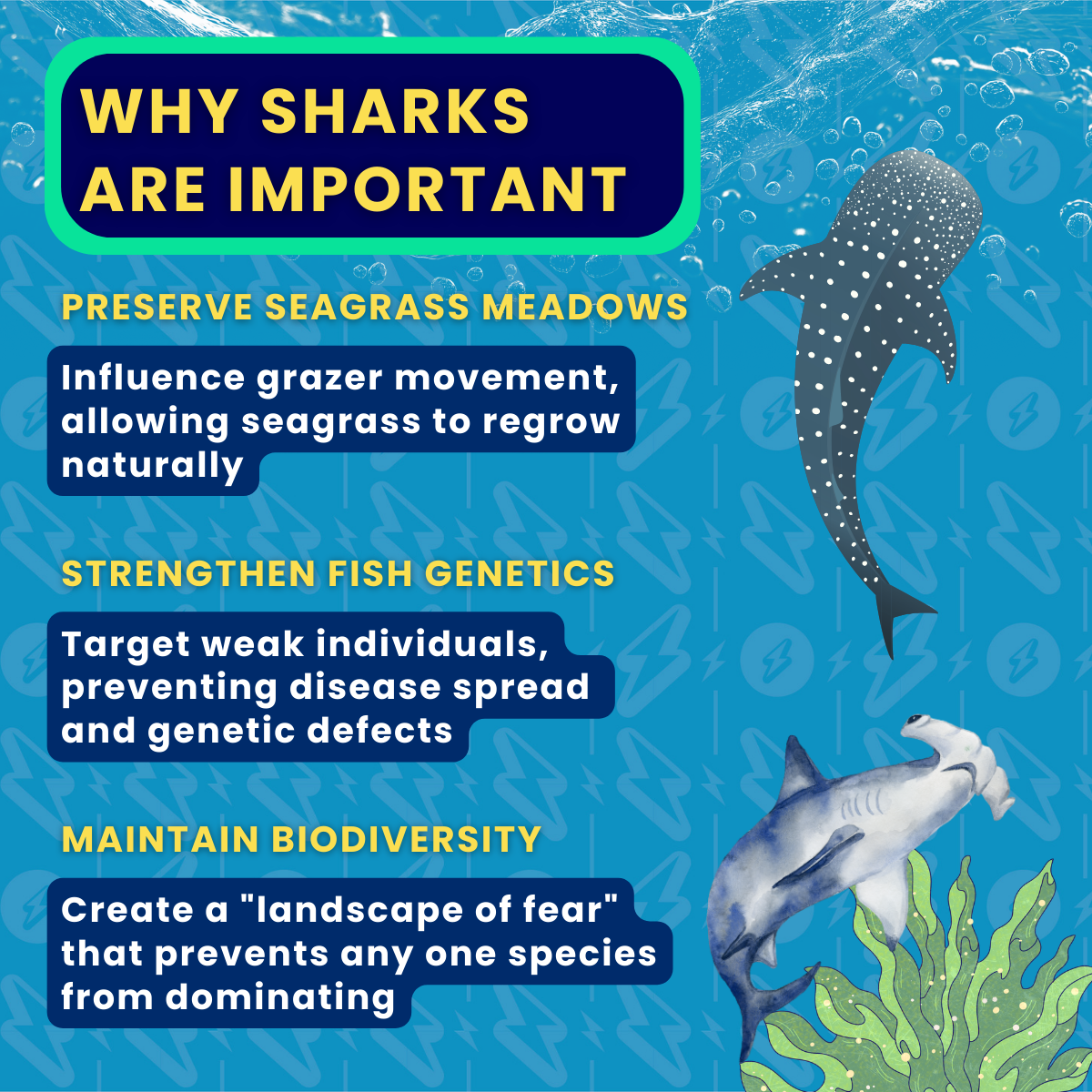
Sharks also protect seagrass meadows by influencing the movement of grazers like sea turtles and dugongs. Instead of hanging about in one area and overfeeding, these animals move more frequently when sharks are nearby, giving seagrass time to regrow.
This natural "grazer rotation" preserves seagrass beds, which are critical habitats for juvenile fish, invertebrates, and other marine species.
When coral reefs, kelp forests, and seagrass meadows thrive, so do the countless species that depend on them.
🦈Sharks are evolution's bouncers
Sharks target weak, sick, or ageing individuals, removing those less likely to survive and reproduce. This natural selection strengthens fish populations over time by allowing the fittest individuals to thrive and pass on their genes.
By culling the sick, sharks help prevent the spread of disease and genetic defects within schools of fish. In some cases, fleeing from sharks even helps fish shed parasites as their scales rub together or against surfaces.
Without sharks, unhealthy or disease-prone fish could multiply unchecked, weakening entire populations and messing up the delicate balance of marine ecosystems.
🦈Sharks maintain biodiversity
Sharks create what scientists call a "landscape of fear", influencing where prey species move and feed. This prevents any one species from dominating an area, allowing multiple species to coexist and reducing the risk of habitat destruction.
Studies suggest that healthy shark populations contribute to overall ecosystem function and enhance resilience to environmental disturbances.
When sharks are removed, food webs become unbalanced, leading to cascading effects that weaken entire ecosystems.
Protecting sharks means protecting the stability of marine environments. It ensures ocean life remains biodiverse, adaptable, and resilient in the face of change.
🦈Sharks help fight climate change
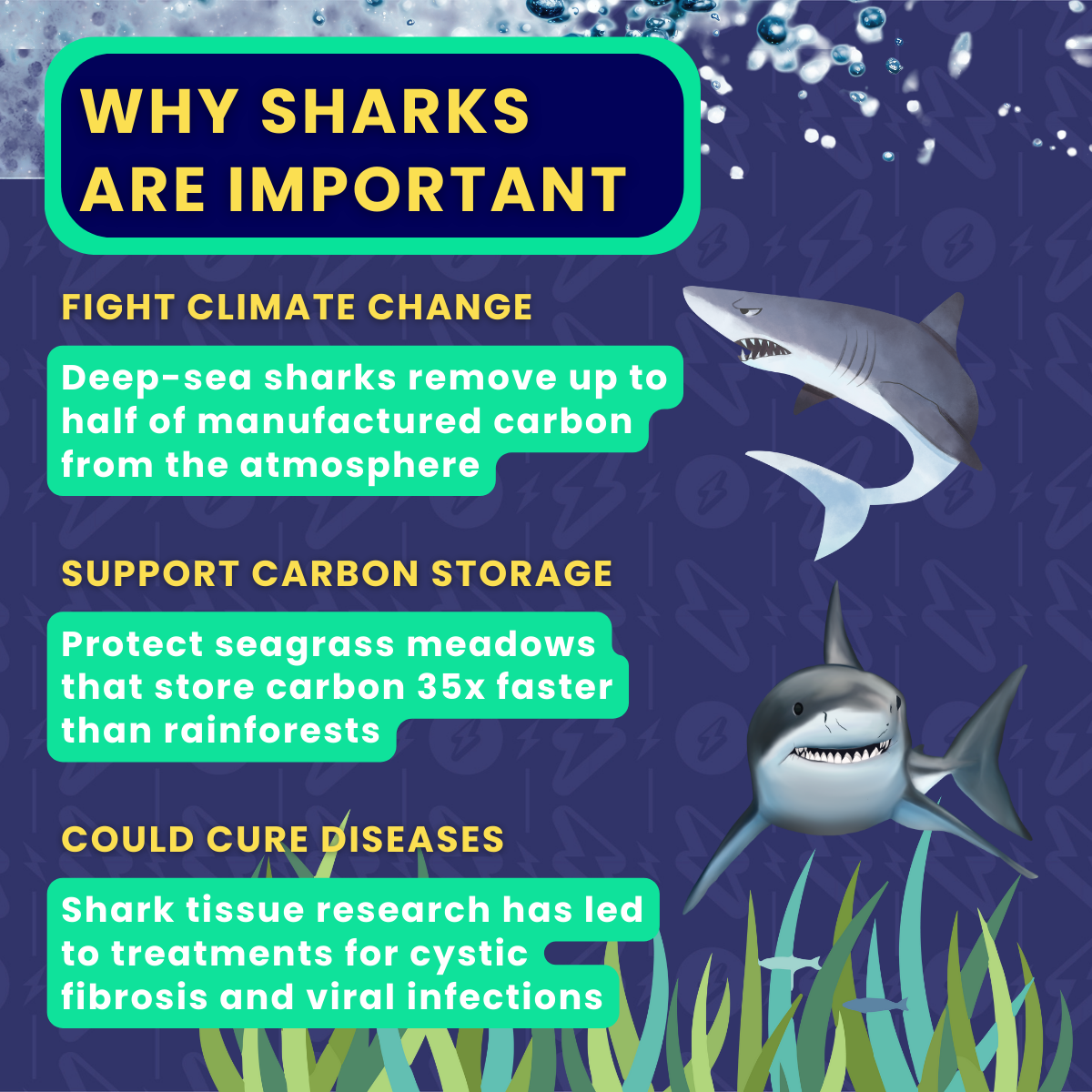
Remember how we mentioned sharks protect seagrass meadows? Well, those underwater grasslands store carbon 35 times faster than tropical rainforests.
By maintaining the balance that keeps these meadows healthy, sharks indirectly support one of nature's most effective carbon storage systems.
Deep-sea sharks help recycle carbon by eating and scavenging dead animals on the ocean floor. Without these sharks, that carbon would rise to the surface and eventually end up back in the atmosphere.
It's estimated that sharks remove up to half of the manufactured carbon in the atmosphere.
Not bad for creatures we've spent decades demonising.
🦈Sharks boost coastal economies
Healthy shark populations support thriving coastal economies through ecotourism. In many parts of the world, people travel specifically for a chance to see sharks in their natural habitat - an experience that generates millions of pounds annually for local communities, dive operators, and tourism businesses.
Shark tourism doesn't just boost income; it builds awareness and support for ocean protection. Many dive operators partner with scientists or participate in citizen science programmes, collecting valuable data on shark behaviour, populations, and habitats.
In most cases, it's far more profitable to keep sharks alive than to kill them for meat or fins.
🦈Sharks could help cure diseases
Even with tonnes of shark research and conservation efforts, there's still so much we don't know about these creatures.
The more we study sharks, the easier it becomes to discover new ways to treat diseases. Treatments for cystic fibrosis and various viral infections have been found through shark research.
Shark tissue works well as an anticoagulant and antibacterial, potentially becoming a potent weapon for scientists and doctors in finding new medicines.
🦈What happens if sharks disappear?
Since sharks help balance the ecosystem, their disappearance would lead to a catastrophic domino effect.
Fish populations would explode out of control, leading to mass shortages of food and other marine resources. As plankton, algae, and other food sources die off, the fish will eventually follow suit, leading to a collapse of the entire marine ecosystem.
Every species within the ecosystem is connected. What happens to one animal, particularly at the top, affects everything else within the system.
If ocean life dies out, climate change will only worsen, leading to more natural disasters and destruction.
Sharks act as an excellent litmus test to show the health of the ocean. The more sharks present, the better it is for the entire ecosystem.
🦈The reality of shark populations
Overfishing and other threats have massively reduced shark populations, altering their roles and effects on ecosystems. Macropredatory sharks are disproportionately affected by humans, yet they're the ones who influence prey and coastal ecosystems most significantly.
Like terrestrial predators, sharks may be crucial to ecosystem functioning under climate change.
But we're running out of time to protect them.
Increasing human uses of oceans are changing shark roles. Rebuilding key populations and incorporating shark ecological roles into management efforts are critical for retaining their functional value.
🦈We need sharks
Sharks aren't the monsters Hollywood makes them out to be.
They're essential guardians of ocean health, climate regulators, and economic assets.
They've been swimming in our oceans for over 400 million years, surviving ice ages, asteroid impacts, and countless environmental changes.
But they might not survive us.
Every time you see a sensationalised shark attack headline, remember what sharks actually do for our planet. They keep our oceans healthy, help fight climate change, and maintain the delicate balance of marine life.
Without them, the ocean ecosystem collapses. And when the ocean dies, we're not far behind.
So the next time someone tells you they're scared of sharks, tell them they should be more scared of a world without them.
Because a world without sharks? That's the real nightmare.
Want content that educates, challenges assumptions, and makes people think? Get in touch. We create marketing that bites back.🦈